
Owner guides — / 03
Not every crack is structural. Here is how to read yours.
The width of a crack tells you very little. Its pattern, its direction and whether it is moving tell you almost everything.
Cracks on a building produce two reactions and both are expensive. One is alarm, which leads to money spent on a facade that was never in danger. The other is the assumption that a building settles and cracks and that is simply what buildings do — which is true right up until the moment it is not.
What separates them is not how wide the crack is. It is the pattern, the direction, and whether it is moving.
Four patterns, in order of how much they should worry you
Fine cracking in a web across the render
Shallow, irregular, covering an area like crazed glaze on pottery. This is shrinkage in the plaster coat, not in the structure behind it.
A straight vertical crack where two materials meet
Typically where blockwork abuts a concrete column or beam. Two materials expand and contract at different rates, and in a country that swings from mid-teens on a winter night to the low forties on a summer afternoon they do so every year of the building's life.
Diagonal cracks from the corners of windows and doors
Openings concentrate stress, so this is where a building shows movement first. The question is whether the movement has stopped. Thermal movement stabilises; settlement may not.
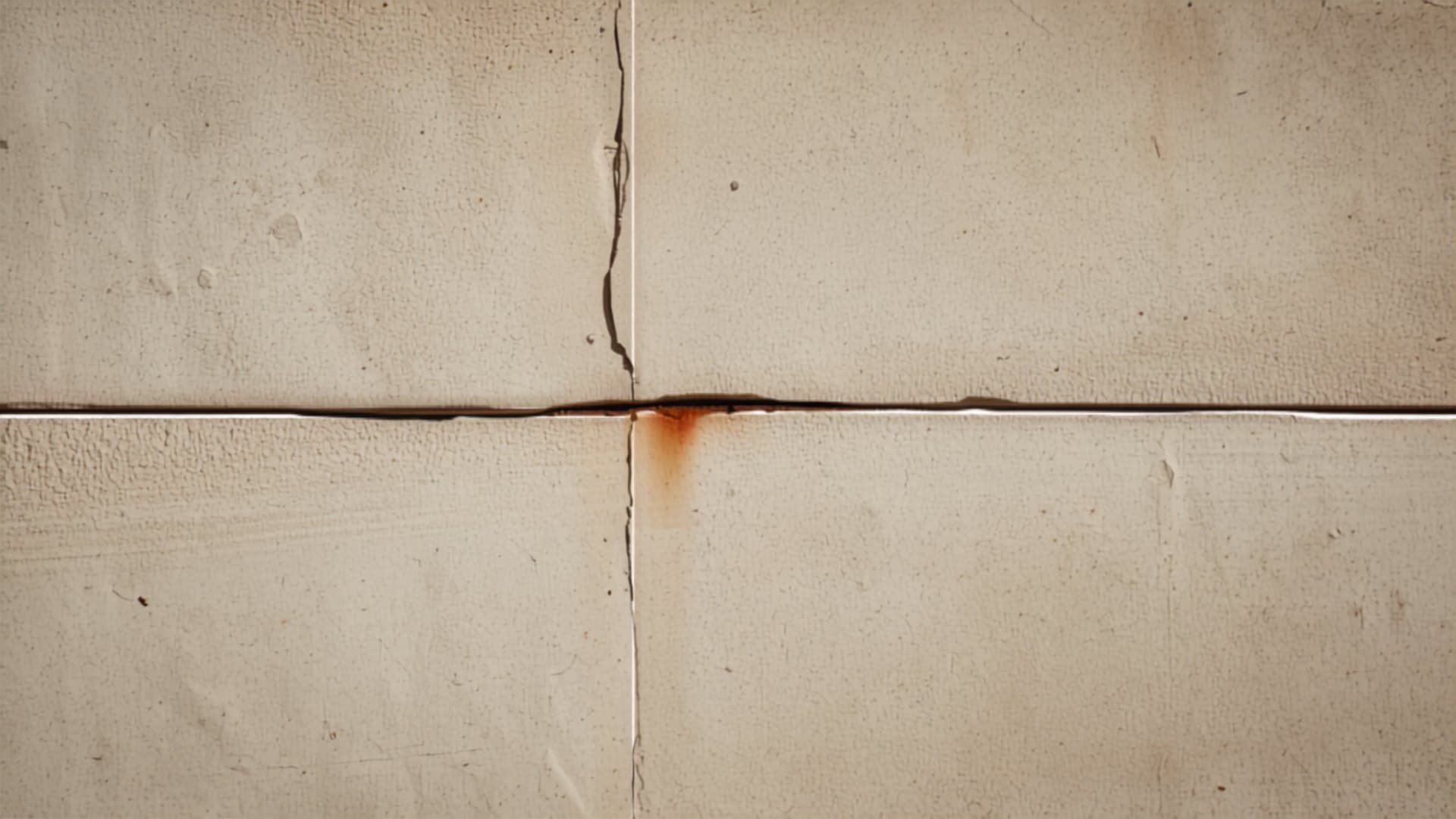
A long straight crack parallel to an edge, with rust-brown staining
Often with a hollow sound when tapped. This one is different in kind from the other three. It is not the concrete failing. It is the steel inside it.
Why the fourth pattern is the one that matters in Bahrain
Reinforced concrete works because the concrete around the steel is alkaline, which keeps a protective film on the bar. Two things destroy that protection: carbonation, which is the concrete slowly reacting with the air, and chloride ions, which arrive from salt.
Bahrain supplies chlorides generously — coastal exposure on every side, high humidity, airborne salt and saline groundwater. Case studies of coastal concrete structures in the Arabian Gulf have documented extensive carbonation and chloride attack producing reinforcement corrosion, cracking and spalling in structures around ten years old. This is the region's characteristic deterioration mechanism, not an unusual event.
Once the bar starts corroding, the mechanism is mechanical. Rust occupies considerably more space than the steel it formed from, so the bar swells inside a material that cannot move. It splits the concrete along its own line — hence the long straight crack that follows the reinforcement — then separates the cover from the bar, then eventually sheds it. That is what spalling is: not the cause, the final stage.
Do this first
Two tests worth doing yourself
Neither needs a specialist, and between them they answer the only two questions that matter.
- 01The tell-tale. Mark both ends of the crack with a pencil line across it and write the date.
- 02Photograph it monthly from the same position, with something for scale in frame. Three or four months answers the only question that matters on a diagonal crack: is it moving, or did it move once and stop. Nobody can tell you that from a single photograph, including us.
- 03The tap test. Tap along and around the crack with the handle of a screwdriver or a small hammer.
- 04Sound concrete rings solid. A dull, hollow sound means the cover has already separated from the steel behind it, even though nothing has fallen and the surface still looks intact.
- 05A hollow area is delaminated concrete and it will come off eventually. Anything hollow above a walkway, a parking bay or an entrance moves up the priority list immediately.
Why painting over it makes it worse
The instinct is to fill and repaint, and on the first two patterns that is roughly the right answer. On a corroding bar it is actively harmful. A coating over rusting reinforcement seals moisture in against the steel, hides the progress from anyone looking, and buys perhaps a season — at the end of which the same crack returns wider, having spent that season corroding out of sight.
The correct repair runs the other way. Break the concrete back beyond the corroded length until sound steel is reached, clean or replace the bar, treat it, rebuild the section with a repair mortar, and only then coat the surface — this time with a system meant to keep chlorides and moisture out rather than to hide what is underneath.
It is more work than a repaint. It is a fraction of the work of doing it after a facade has begun shedding.
Where the line is
Cracking that is widening measurably, cracking that runs through a structural element rather than through render, cracking with displacement — one side sitting proud of the other — or extensive delamination is beyond visual diagnosis. That needs a qualified structural assessment, and anyone who gives you a verdict on it from a photograph is guessing.
The first three patterns are maintenance. The fourth is a clock, and it only runs one way.
If you have rust staining on a facade, photograph it and mark the date.
Al Wajaha Projects has looked after buildings in Bahrain since 1987, across maintenance, renovation and construction. Send the photograph and we will tell you whether you are looking at render or reinforcement.